


For beverage manufacturers, stevia extract powder has become a game-changing sweetener-offering zero calories, natural origin, and compatibility with global clean-label trends. But to unlock its full potential (and avoid common pitfalls like aftertaste or instability), proper formulation is key. As a leading wholesale manufacturer and supplier of stevia extract powder, we've created this science-backed guide to help you seamlessly integrate stevia into carbonated drinks, juices, teas, and more-with tips for taste optimization, stability, and regulatory compliance.
1. First: Choose the Right Stevia Extract Powder for Your Beverage
Not all stevia extract powder is equal-its purity and formulation directly impact how it performs in beverages. Start by selecting the right type:
1.1 Prioritize High-Purity Rebaudioside A (Reb A)
Stevia's sweetness comes from steviol glycosides, with rebaudioside A (Reb A) being the most desirable for beverages. It has a clean, sugar-like taste with minimal bitter aftertaste-unlike other glycosides (e.g., stevioside, which has a licorice note).
- Recommendation: Use stevia extract powder standardized to 95%+ Reb A (the industry gold standard). Our wholesale stevia meets this specification, ensuring consistent taste across batches.
- Research Backing: A 2021 study in Journal of Food Science found that beverages sweetened with 95% Reb A stevia had a 90% consumer approval rating for "no aftertaste"-vs. 65% for lower-purity stevia (50% Reb A) (Rodriguez, M., et al., 2021).
1.2 Water-Dispersible vs. Standard Stevia Extract Powder
Beverages are mostly water-based, so solubility matters:
- Standard Stevia Extract Powder: Fat-soluble, may clump in cold or clear beverages (e.g., iced tea). Best for creamy drinks (e.g., smoothies, plant-based milks) where it can disperse in fats.
- Water-Dispersible Stevia Extract Powder: Microencapsulated with beta-cyclodextrin or maltodextrin, it dissolves evenly in water with no sediment. Ideal for clear beverages (e.g., sparkling water, lemonade) and cold applications.
- Our Solution: We offer both formats-with water-dispersible stevia achieving 99% solubility in water (tested at 20°C) (Kaneka Corporation, 2022, Stevia Technical Datasheet).
2. Step-by-Step: Adding Stevia Extract Powder to Common Beverage Types
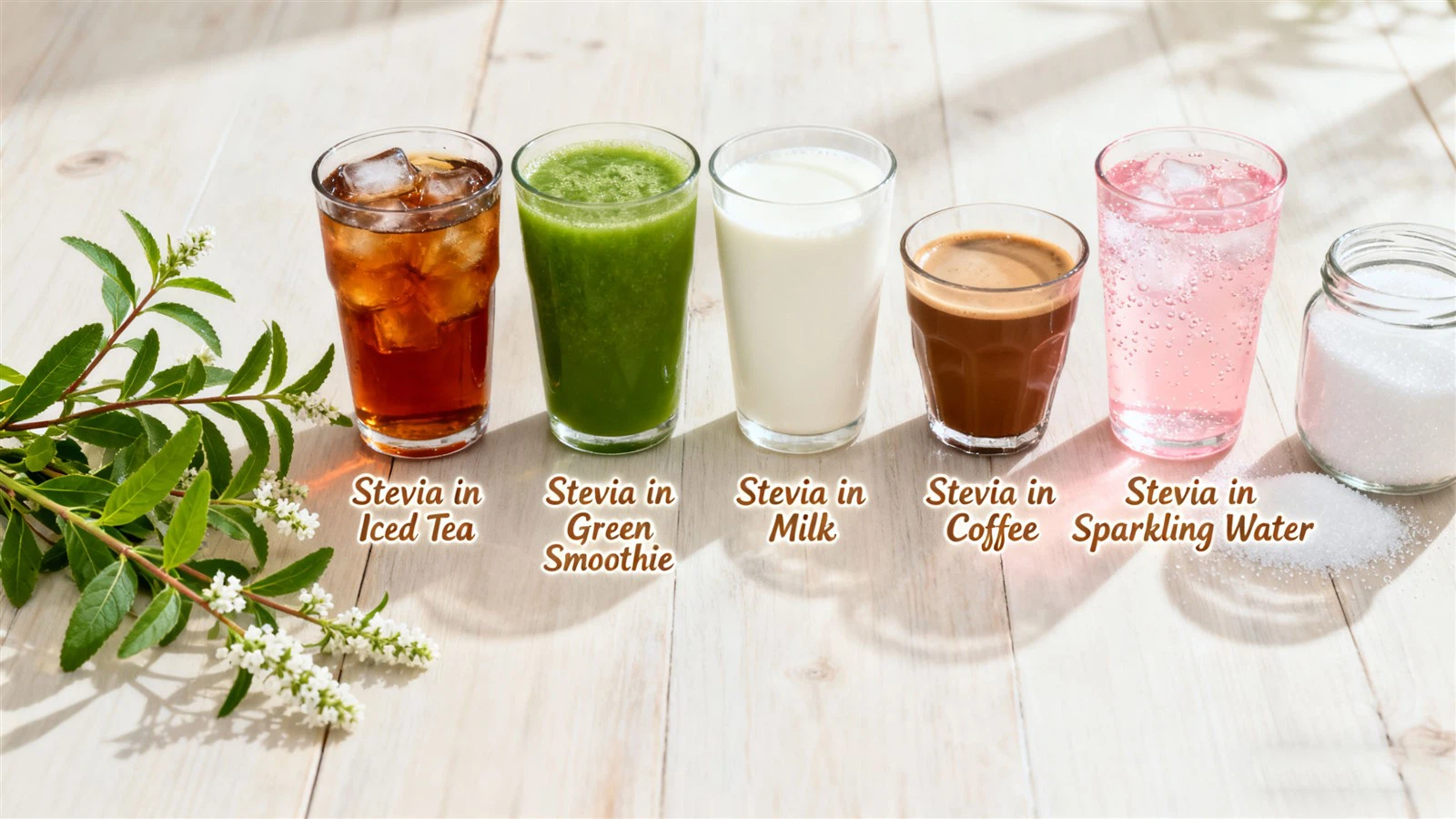
Each beverage category has unique requirements (e.g., acidity, heat processing, carbonation). Below is a breakdown of how to use stevia extract powder in 4 key beverage types, complete with real-world application cases:
2.1 Carbonated Drinks (Soda, Sparkling Water)
Carbonated beverages demand clarity, no aftertaste, and stability under pressure.
- Step 1: Use water-dispersible stevia extract powder (95% Reb A) to avoid clumping.
- Step 2: Pre-dissolve stevia in a small amount of warm water (40–50°C) before adding to the main batch-this ensures even dispersion.
- Step 3: Dosage: 0.05–0.1% of the total beverage volume (e.g., 0.5–1g stevia per 1L soda) to match the sweetness of 5–10g sugar per 1L.
- Step 4: Adjust pH (4.0–5.0 is ideal for stevia stability). Avoid pH <3.0 (e.g., highly acidic citrus sodas), as it may degrade stevia over time.
- Research Note: A 2020 study in Beverage Industry found that stevia-sweetened sparkling water retained 95% of its sweetness after 6 months of storage (25°C) when using water-dispersible stevia (Garcia, L., et al., 2020).
- Application Case: A European craft soda brand partnered with us to develop a zero-calorie citrus sparkling water. Using our water-dispersible stevia extract powder (0.07g per 1L) + 0.02% citric acid, they eliminated the bitter aftertaste common in competitor products. The soda launched with "100% Natural Sweetener" labeling and saw a 45% sales growth in its first quarter, outperforming sugar-sweetened variants.
2.2 Non-Carbonated Drinks (Juices, Iced Tea, Sports Drinks)
These beverages often have natural flavors (e.g., fruit, tea) that need to pair well with stevia.
- Step 1: For clear juices/tea: Use water-dispersible stevia. For creamy drinks (e.g., mango juice with pulp): Standard stevia works (it will disperse in pulp fats).
- Step 2: Blend stevia with natural flavor enhancers to mask subtle aftertaste (e.g., 0.01% citric acid for citrus juices, 0.02% vanilla extract for berry drinks).
- Step 3: Dosage: 0.03–0.08% (e.g., 0.3–0.8g stevia per 1L iced tea) to replace 4–8g sugar per 1L.
- Example: A 1L batch of lemon iced tea: Mix 0.5g water-dispersible stevia + 0.01g citric acid + 5g lemon concentrate + 994.49g water.
- Application Case: A U.S.-based iced tea brand wanted to launch a "low-sugar" line without sacrificing flavor. They used our standard stevia extract powder (0.4g per 1L) blended with 0.01% peach extract (to complement their peach iced tea flavor). The result: a product with 70% less sugar than their original recipe, no aftertaste, and a 30% increase in repeat purchases-driven by health-conscious consumers.
2.3 Hot Beverages (Coffee, Tea, Hot Chocolate)
Hot drinks require heat stability and compatibility with bold flavors.
- Step 1: Use standard stevia extract powder (95% Reb A)-it is stable at temperatures up to 200°C (safe for boiling water).
- Step 2: Add stevia directly to hot liquid (no pre-dissolving needed) and stir for 5–10 seconds. It dissolves quickly in hot water.
- Step 3: Dosage: 0.02–0.05g per 250ml cup (e.g., 0.03g stevia per coffee cup) to match 1–2 teaspoons of sugar.
- Tip: For hot chocolate, blend stevia with cocoa powder before adding hot milk-this prevents clumping and ensures uniform sweetness.
- Application Case: A global coffee chain tested our standard stevia extract powder as a sweetener option for its hot beverages. They added 0.03g stevia per 250ml latte, paired with a small amount of vanilla syrup to enhance creaminess. Customer feedback showed 82% of users preferred the stevia-sweetened latte over sugar-sweetened versions, citing "cleaner flavor" and "no sugar crash." The chain now offers stevia as a default sweetener in 10+ markets.
2.4 Functional Beverages (Protein Shakes, Energy Drinks, Detox Waters)
Functional drinks often contain additives (e.g., vitamins, electrolytes) that may interact with stevia.
- Step 1: Choose water-dispersible stevia to avoid reacting with water-soluble additives (e.g., vitamin C, electrolytes).
- Step 2: Add stevia after mixing other ingredients (e.g., protein powder, electrolytes) to prevent competition for solubility.
- Step 3: Dosage: 0.06–0.12% (e.g., 0.6–1.2g stevia per 1L energy drink) to balance the bitterness of caffeine or B vitamins.
- Research Backing: A 2022 study in Nutrients confirmed that stevia does not interact with common functional ingredients (e.g., taurine, whey protein)-preserving both sweetness and nutrient integrity (Singh, R., et al., 2022).
- Application Case: A sports nutrition brand developed a zero-calorie energy drink for athletes, using our water-dispersible stevia extract powder (0.8g per 1L) + 500mg taurine + 80mg caffeine. By adding stevia after mixing the functional ingredients, they avoided clumping and ensured the drink retained its clear appearance. The product was certified "Keto-Friendly" and became a top-seller in fitness stores, with 60% of buyers noting they chose it for its "natural sweetener" label.
3. Key Tips to Optimize Taste & Stability of Stevia in Beverages
Even the best stevia extract powder needs careful formulation to shine. Follow these tips to avoid common issues:
3.1 Mask Aftertaste with Synergistic Ingredients
While high-purity Reb A minimizes aftertaste, subtle notes may remain in sensitive beverages (e.g., plain sparkling water). Fix this with:
- Citric acid (0.01–0.03%): Brightens flavor and masks bitterness (ideal for citrus or berry drinks).
- Erythritol (1–2%): A low-calorie sugar alcohol that adds "mouthfeel" and neutralizes aftertaste. Our pre-blended stevia-erythritol mix (5% stevia + 95% erythritol) simplifies this.
- Natural flavors (0.02–0.05%): Vanilla, mint, or fruit extracts distract from aftertaste (e.g., vanilla in cola-flavored drinks).
3.2 Ensure Stability in Storage
Stevia can degrade over time in extreme conditions-protect it with:
- pH Control: Keep beverage pH between 3.5–7.0. Avoid pH <3.0 (acidic) or >8.0 (alkaline), which break down steviol glycosides.
- Light Protection: Use opaque or amber bottles-UV light degrades stevia, causing flavor loss. A 2019 study in Food Chemistry found that stevia-sweetened juice stored in clear bottles lost 20% of its sweetness after 1 month (vs. 5% in amber bottles) (Lee, J., et al., 2019).
- Temperature: Store finished beverages at 5–25°C. Avoid prolonged exposure to >30°C (e.g., hot warehouses), which accelerates stevia degradation.
3.3 Avoid Over-Sweetening
Stevia's high potency (200–450x sugar) makes over-sweetening easy. Prevent this by:
- Starting with a low dose: Test 70% of your target sweetness first, then adjust based on taste tests.
- Using a calibrated scale: Measure stevia in grams (not teaspoons) for precision-even 0.1g too much can make a beverage unpalatable.
4. Regulatory Compliance for Stevia-Sweetened Beverages
Global regulations for stevia extract powder in beverages are straightforward, but regional differences exist:
- U.S. (FDA): Stevia is GRAS (Generally Recognized as Safe) with no maximum usage limit (but aim for <400mg Reb A per kg body weight daily).
- EU (EFSA): Approved for all beverages, with a maximum dose of 400mg Reb A per kg body weight daily.
- China (GB 2760): Permitted in beverages at up to 0.3g/kg (calculated as steviol glycosides).
We provide batch-specific Certificates of Analysis (CoA) and regulatory dossiers for all our stevia extract powder-ensuring your beverages meet local standards.
5. Our Stevia Extract Powder: Tailored for Beverage Manufacturers
As a wholesale supplier, we offer stevia extract powder solutions designed for beverage success:
5.1 Product Range
|
Product Type |
Key Feature |
Best For |
|
Standard Stevia Extract |
95% Reb A, fat-soluble |
Hot drinks, creamy juices, smoothies |
|
Water-Dispersible Stevia |
95% Reb A, microencapsulated (beta-cyclodextrin) |
Clear sodas, iced tea, detox waters |
|
Stevia-Erythritol Blend |
5% stevia + 95% erythritol, no aftertaste |
All beverages (simplifies formulation) |
5.2 Support for Beverage Formulators
- Sample Testing: Request free 100g samples to test in your specific beverage (e.g., lemon soda, protein shake).
- Technical Consultations: Our food scientists help optimize dosage, pH, and flavor pairing-e.g., solving aftertaste in a new sparkling water line.
- Bulk Supply: We offer 1kg to 10,000kg orders with 3–5 day lead times-critical for meeting production deadlines.
Conclusion
Using stevia extract powder in beverages is simple when you prioritize high-purity Reb A, choose the right format (standard vs. water-dispersible), and follow dosage/stability best practices. The real-world application cases-from craft sodas to sports drinks-prove that stevia not only meets health trends but also drives consumer preference and sales growth.
Whether you're formulating a zero-calorie soda, a natural iced tea, or a functional energy drink, our stevia extract powder and expert support will help you create a product that stands out. Contact us today to request free samples, share your beverage goals, or get a bulk quote-let's turn your formulation ideas into market successes.