


Most ube powder quotations that look "wrong" are not wrong at all. They are simply quoting a different product than the one the buyer had in mind. Three variables decide everything: how fine the powder is milled, how much pigment survived the drying line, and which compliance grade the batch was produced under. Get those three aligned and the price gap collapses to a normal commercial spread.
1. The three-axis specification framework
An ube powder specification is a coordinate, not a single number. Mesh size, color grade and purity grade are independent axes. A 200-mesh powder is not automatically better than an 80-mesh powder; a food-grade material is not interchangeable with an industrial-grade one even when both read "99% purity" on a certificate of analysis.
|
|
Direct answer Mesh size (80 / 100 / 120 / 200 mesh) controls hydration speed, mouthfeel and dispersion behaviour, and should be chosen from your process rather than from a habit of "finer is better." Color grade controls how much pigment you must dose, and is defined by anthocyanin content plus a measured L*a*b* window. Purity grade controls legal market access: carrier-free food grade, carrier-standardised food grade, feed/pet grade, cosmetic-technical grade, and standardised extract grade each carry different contaminant limits and documentation. |

2. Settle the botanical question before you settle the price
In international trade the word "ube" is used loosely, and that looseness costs buyers money. True ube is Dioscorea alata - a yam in the family Dioscoreaceae, native to Southeast Asia and the cultural anchor of Filipino desserts. Purple sweet potato is Ipomoea batatas, a morning-glory-family root, and the dominant purple raw material in mainland Chinese production.
They are not the same ingredient, and the difference shows up in three places your customer will notice:
- Flavour. Ube carries a distinct sweet, nutty, vanilla-adjacent aromatic profile. Purple sweet potato is milder, more earthy, and closer to a plain steamed root. Swap one for the other in an ice cream base and a trained sensory panel will find it in a triangle test.
- Pigment profile. Both rely on anthocyanins, but ube's acylated cyanidin and peonidin glycosides behave differently from sweet potato pigment in heat and pH stress, which changes how the colour holds in a bake.
- Label and legal exposure. If your front-of-pack says "ube" and the incoming material is sweet potato, you own that mismatch. This is why serious buyers now require a species confirmation - botanical identification, and where authenticity risk is high, a PCR-based species check.
Both materials can be excellent ingredients. What matters is that the specification names the species explicitly, and that the certificate of analysis is issued against that named species. Blends are commercially available and perfectly legitimate; undisclosed blends are not.
3. Mesh size: what 80, 100, 120 and 200 actually mean
"Mesh" is a sieve count, not a measurement. It tells you how many openings fit per linear inch of a standard woven-wire screen, which means the micron figure changes depending on whether the supplier is working to ASTM E11 or ISO 3310-1. The floor is fixed by the standards, but the marketing is not - always ask for the nominal aperture in micrometres and the declared pass rate.
| Mesh designation | Nominal aperture | Chinese trade term | Typical pass specification |
|---|---|---|---|
| 80 mesh | 180 µm | 八十目 | 95% min. through 80 mesh |
| 100 mesh | 150 µm | 一百目 | 95% min. through 100 mesh |
| 120 mesh | 125 µm | 一百二十目 | 98% min. through 120 mesh |
| 200 mesh | 75 µm | 二百目 | 98% min. through 200 mesh |
| 325 mesh (extract work only) | 45 µm | 三百二十五目 | 99% min. through 325 mesh |
The 180 down to 75 micrometre span looks narrow on paper. In a production line it is the difference between a powder that hydrates in under a minute and one that leaves grit in a beverage.
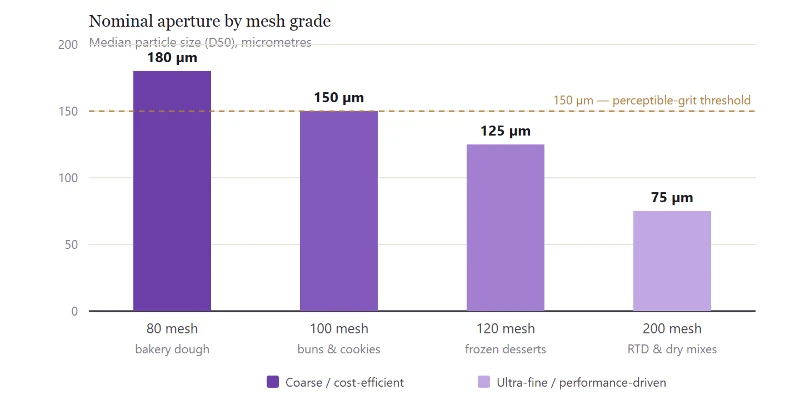
Figure 1 - Particle size falls as mesh count rises, but the commercial value of that fineness depends entirely on the application. Note that aperture values are nominal ASTM E11 designations and shift slightly under ISO 3310-1 tolerances.
What mesh size actually changes in your process
Four physical effects matter, and none of them is "quality."
Hydration and dispersion. Reducing D50 from 180 µm to 75 µm multiplies the accessible surface area by roughly 2.4× for the same mass. In practice this is what separates a powder that wets out in 45 seconds under standard industrial agitation from one that forms dry-centred aggregates and needs a high-shear pass. For ready-to-drink formats and instant dry mixes, the practical minimum is 95% passing a 100-mesh sieve; below that, coarse particles never fully hydrate and register as grit.
Mouthfeel. In fine suspensions, individual particles above roughly 150 µm become detectable by trained panels in dairy and dessert matrices. This is why 80-mesh material is a baking workhorse and a poor choice for a chilled latte.
Suspension behaviour. Finer particles sediment more slowly and stay suspended longer, which matters for bottled beverages and frozen desserts where phase separation over 24 hours is a defect. In a standard monitoring test, a good 200-mesh batch shows minimal phase separation and no dense starch pad at the vessel bottom after 24 hours.
Milling economics. This is the part buyers rarely hear. Yield loss rises steeply as you push past 120 mesh, because the separating step rejects more oversize material, and the mill generates more frictional heat. Heat is the enemy of anthocyanin. A supplier running a poorly cooled ultrafine mill can deliver a beautiful 200-mesh particle size alongside a measurably duller colour. Ultrafine mesh and high colour value must be verified together, never assumed to travel as a pair.
|
|
Common misconception worth correcting Mesh size does not determine colour intensity. A 80-mesh high-color grade powder can be far more saturated than a 200-mesh light grade. Buyers who specify "200 mesh" believing it guarantees a deeper purple are optimising the wrong variable - and often paying an extra milling premium for a colour they still have to over-dose. |
4. Color grade: the axis most RFQs get wrong
Colour is not a description, it is a measurement. Three instruments of record are used in commercial contracts, and a serious supplier will report all three without being asked twice.
4.1 How colour is quantified
- CIE L*a*b* (CIE 1976 colour space). L* is lightness, a* is the red–green axis, b* is the yellow–blue axis. For ube specifically, a credible deep batch sits around L* 45–58, a* 8–14 and b* between −1 and −4. That negative b* is the signature: it is the cool blue undertone that separates authentic violet from a flat reddish-maroon.
- ΔE*ab (colour difference). The batch-to-batch tolerance in your contract. A working commercial target is ΔE ≤ 3 against an approved reference, measured on a fixed powder sample geometry. Anything above that and your customers will see shade drift between production lots.
- Total monomeric anthocyanin content. Measured by the pH-differential spectrophotometric method, standardised as AOAC Official Method 2005.02 and described in the Giusti & Wrolstad characterisation work that most pigment laboratories still follow. Reported as mg per 100 g of dry matter, or as a percentage by UV-Vis.
For pigment concentrates, a fourth figure appears: colour value E (E1%1cm), the absorbance of a 1% solution in a pH 3.0 buffer read at the anthocyanin λmax, typically near 520 nm. Colour value is the most useful single number for procurement because it converts directly into dosing cost.
| Grade | Anthocyanin | Colour value E1%1cm | Typical L* / a* / b* | Where it earns its price |
|---|---|---|---|---|
| HC - High colour deep violet |
300–500 mg/100 g | ≥ 30 | 45–52 / 10–14 / −2 to −4 | Deep purple breads and buns, mochi, premium gelato, ube halaya, colour-critical bakery exports |
| SC - Standard colour true violet |
150–300 mg/100 g | 15–29 | 53–58 / 8–12 / −1 to −3 | Everyday bakery and confectionery, ice cream, yoghurt and dairy analogues, general-purpose colour |
| LC - Light colour lilac / pastel |
60–150 mg/100 g | 8–14 | 62–72 / 5–9 / 0 to −2 | Pastel drinks and lattes, layered desserts, noodles and dumpling wrappers, cosmetics and masks |
| X - Extract grade standardised |
5–25% (UV/HPLC) | ≥ 150 | reported on dilution | Nutraceutical capsules, functional blends, colour formulations where mass addition is constrained |
Note the pattern. Anthocyanin content and colour value rise together, and L* falls as the powder gets deeper. If a supplier quotes a "deep purple" grade with L* around 68, the powder is not deep - the descriptor is doing work the pigment cannot.
4.2 Deep versus light: matching shade to scenario
The instinct to always buy the deepest grade is understandable and frequently wrong. A few patterns hold across markets:
Deep grades (HC) suit applications where colour is the selling proposition and the matrix is opaque: laminated breads, swirled buns, mochi, ube-flavoured ice cream, cookies meant to photograph well. These are also the applications where you can least afford under-dosing, because a weak purple reads as grey or muddy in a baked crumb.
Light grades (LC) suit transparent or water-continuous systems: milk teas, layered lattes, pastel macarons, and clear-ish beverages where a high-load dose would push the product toward an opaque, chalky look. They also serve noodle and dumpling-wrapper applications, where the target is a soft, even lilac rather than saturation, and cosmetics, where a lighter powder blends more gracefully into a cream base.
Matching shade to substrate is a chemistry question as much as an aesthetic one. A dairy matrix at pH 6.5 shifts anthocyanins toward blue-grey and accelerates degradation; an acidified beverage at pH 3.5 stabilises them into a bright magenta-violet. The same powder can look two different colours in two formulations, so specify the shade after you know your pH.
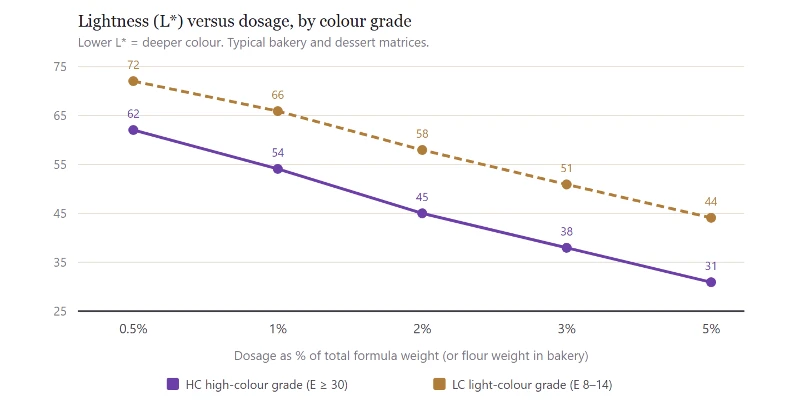
Figure 2 - Indicative dose–response behaviour in a neutral, opaque matrix. The two curves never converge: an HC powder reaches at 1% the depth an LC powder only approaches at 5%, which is precisely why the cheaper-per-kilogram grade is often the more expensive choice. Validate against your own formulation; starch, fat and pH all move these curves.
4.3 The chemistry that decides whether your colour survives
Purple root pigments are anthocyanins, water-soluble flavonoid glycosides. Purple sweet potato carries a distinctive set of them: work published by Terahara and co-workers identified nine acylated anthocyanins in the species, based mainly on cyanidin and peonidin cores with aromatic acid acylation. That acylation is not a footnote. Acylated anthocyanins are measurably more resistant to heat and to pH shift than the simple, non-acylated forms found in many berries, because the acyl groups stack against the flavylium ring and shield it from nucleophilic attack by water.
Practical consequences you can plan around:
- pH is the master variable. Below pH 3 the pigment reads bright magenta; between pH 3 and 5 it settles into the violet register most consumers associate with ube; above pH 6 it drifts blue-grey and degradation accelerates sharply. In dairy and plant-milk bases, either acidify deliberately or accept a shorter colour hold and adjust your shelf-life claim.
- The native starch matrix is an ally. Residual root starch in a whole-food powder physically protects pigment molecules during thermal processing. This is one reason a genuine whole-root powder can outperform a highly purified extract in a bake, even at the same anthocyanin number. Extraction removes the protection; the trick is to keep the starch and control the moisture.
- Moisture is a stability parameter, not just a handling one. Excess water drives enzymatic browning and sugar–protein reactions that push the shade toward brown. Holding loss on drying at or below 7.5% is standard practice; premium specifications run tighter, and a maximum of 5% is not unusual for export-grade material destined for long ambient storage.
5. Purity grade: food, feed, cosmetic and industrial
"Purity" in powders this simple has two meanings and they get conflated constantly. The first is compositional: is the powder 100% root, or is it standardised with a carrier? The second is compliance: which regulatory regime was the batch produced and documented for? A product can be 100% pure root material and still be industrial grade, if it was dried on equipment also used for solvent-extracted material and cannot produce the paperwork a food importer needs.
| Grade | Composition | Defining limits | Documentation |
|---|---|---|---|
| Food grade, carrier-free | 100% root or tuber powder, no maltodextrin, no flow agents | Moisture ≤ 7.5%; ash ≤ 5%; Pb ≤ 0.5 mg/kg; As ≤ 1.0 mg/kg; Cd ≤ 0.1 mg/kg; Hg ≤ 0.02 mg/kg; TPC ≤ 104 cfu/g; yeast & mould ≤ 300 cfu/g; E. coli and Salmonella absent | COA per batch, third-party report (SGS / Eurofins / Pony), ETO-free declaration, non-GMO statement, allergen statement, irradiation-free declaration |
| Food grade, carrier-standardised | Typically 70–90% root powder plus maltodextrin or a starch carrier | Same contaminant limits as above, but colour value normalised to a fixed target; carrier must appear on the ingredient list | As above, plus quantitative carrier declaration |
| Feed / pet grade | Root powder, often a lower colour fraction or a higher-fibre side stream | Heavy metals typically total ≤ 10 mg/kg; wider microbiological windows; no food-additive compliance | COA, aflatoxin and mycotoxin panel; feed-registration documents where applicable |
| Cosmetic / technical grade | Root powder or pigment concentrate; extraction solvents may be used | Colour and microbial control per cosmetic brief; residual solvent must be declared; no food contaminant regime | Cosmetic ingredient dossier (EU CPR / US MoCRA), residual solvent report, heavy metal panel |
| Standardised extract grade | Anthocyanin concentrate standardised to 5–25% | Assay by UV-Vis or HPLC; residual solvent limits; carrier quantified | Assay method statement, residual solvent report, nutraceutical compliance pack |
5.1 Carrier-free or standardised? The honest trade-off
Carrier-free material gives you a clean label - one ingredient on the pack, and a stronger story for the "100% purple sweet potato" claim that drives premium positioning. It also means you absorb the natural variation of an agricultural crop, so batch-to-batch colour drift is larger and your R&D has to build tolerance into the formula.
Standardised material trades label simplicity for consistency. A maltodextrin-extended powder can be dialled to a fixed colour value so that lot 12 performs exactly like lot 1, which is worth real money on a high-speed filling line. The cost is disclosure: the carrier must be declared, and for brands built on a single-ingredient claim, that is a commercial decision rather than a technical one. Neither option is superior. Choosing the wrong one for your brand position is what causes trouble.
5.2 Market access: the regulations that actually gate shipments
- United States. Facility registration with the FDA, compliance under the Food Safety Modernization Act including the Foreign Supplier Verification Program for importers, and correct colour classification. Purple root concentrates are commonly positioned as vegetable juice colour, which is permitted under the vegetable juice colour provision of 21 CFR Part 73 rather than as a certified colour additive.
- European Union. Two distinct paths. If the material is used as a colouring food - a food with a secondary colouring function - labelling depends on national implementation rather than an E-number. If the anthocyanins are selectively extracted, the product may instead be assessed as a food additive. Contaminant compliance follows the EU contaminants regulation, and the ethylene oxide prohibition is rigidly enforced on dried plant material; an ETO-free declaration is effectively mandatory for EU-bound shipments.
- China. Compliance with the relevant national food safety standards for contaminants, pesticide residues and microbiological limits, with purple sweet potato pigment recognised as a permitted natural colourant.
- Certification stack. ISO 9001 and ISO 22000 are baseline. For retail and ingredient buyers in Europe and North America, a GFSI-benchmarked scheme such as FSSC 22000 or BRCGS is now the practical entry ticket. Kosher, Halal, USDA Organic and EU Organic certificates widen the addressable market considerably, and Non-GMO status demonstrated by PCR testing carries more weight with technical buyers than a self-declaration.
6. What your process will do to the colour
Retention data is where supplier claims and production reality diverge most. The chart below shows indicative retention curves for a well-processed, acylated-pigment whole-root powder against a conventionally dried powder of comparable nominal colour, across thermal loads typical of commercial food manufacturing.
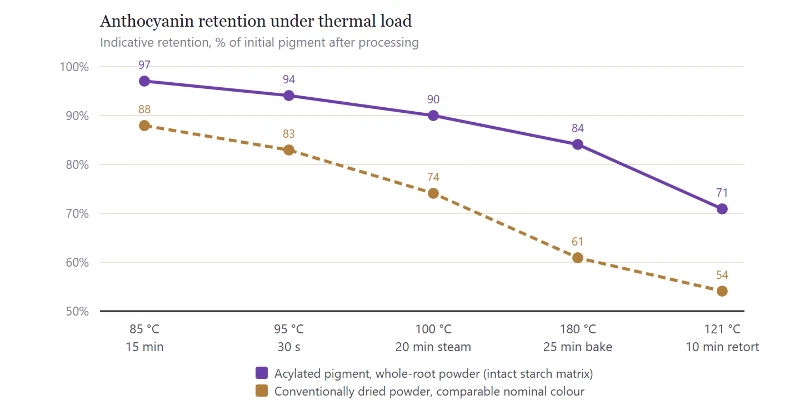
Figure 3 - Indicative retention ranges compiled from published anthocyanin degradation behaviour and application-trial experience. The gap widens with thermal severity: at pasteurisation conditions the two powders are nearly equivalent, while under retort the difference approaches twenty points. These values are guidance for trial design, not guarantees - validate in your own matrix before committing to a colour claim on pack.
Two design rules follow. First, add the powder as late as your process allows. Dropping ube powder into a batter after the bulk has cooled, or into a beverage base after pasteurisation, is the single cheapest way to protect colour. Second, acidify where the product permits. Shifting a neutral dairy base from pH 6.5 toward 4.5 keeps the shade in the violet register and slows degradation, provided the formula tolerates the acid.
On storage, vacuum-sealed foil laminated packaging held in cool, dark, controlled conditions supports a 24-month shelf life as commonly stated on specification sheets. Keep the material away from light and oxygen ingress, and re-test colour after any repackaging step: colour drift during storage is measured as a rise in L*, and a rise of more than two to three units will be visible in finished product.
7. Application selection matrix
This is the table to bring into your next NPD meeting. Recommended values assume a neutral matrix and typical commercial colour expectations.
| Application | Mesh | Colour grade | Purity grade | Starting dose | Watch out for |
|---|---|---|---|---|---|
| Artisan bread, buns, lamination | 80–100 | HC | Food, carrier-free | 3–8% | Gluten dilution at high load; crumb greying if pH drifts |
| Cookies, cakes, sponge | 100 | SC–HC | Food, either | 2–6% | Over-browning at high top heat masking the purple |
| Ice cream, gelato, frozen desserts | 120 | SC–HC | Food, carrier-free | 1–5% | Ice-crystal growth; colour fading in freeze–thaw cycles |
| RTD latte, milk tea, smoothies | 200 | LC–SC | Food, carrier-free | 0.5–1% | Sedimentation; grittiness if mesh is under-specified |
| Instant drink powder, dry blends | 200 | SC | Food, standardised is acceptable | 1–3% | Clumping on reconstitution; moisture pickup in the blend |
| Noodles, dumpling and wonton wrappers | 100–120 | LC–SC | Food, carrier-free | 2–5% | Colour loss in boiling water; dough strength changes |
| Frozen tangyuan, filled mochi | 120 | HC | Food, carrier-free | 3–8% | Colour migration into filling; texture in freeze–thaw |
| Chocolate, compounds, fillings | 120–200 | HC | Food, carrier-free | 2–6% | Water activity increase; use pre-blending with sugar or cocoa |
| Yoghurt and dairy analogues | 120 | SC | Food, either | 1–4% | pH-driven shift toward blue-grey; syneresis |
| Nutraceutical blends, capsules | 200 or extract | X | Extract grade | 300–1000 mg/dose | Assay method must be agreed in writing before first lot |
| Pet food, treats, feed | 80–100 | Any available fraction | Feed grade | 1–5% | Never cross-ship feed-grade lots into food channels |
| Cosmetic masks, creams | 200 | LC | Cosmetic grade | formula-specific | Microbial limits and preservative compatibility |
8. Cost-in-use: why price per kilogram is the wrong number
Buyers compare quotations per kilogram because it is the number on the page. The number that determines product cost is cheaper to derive and matters far more:
|
The calculation Cost per unit of delivered colour = price per kg ÷ (colour value × dosing efficiency) Dosing efficiency is the fraction of pigment that survives your process and actually shows, so it folds in thermal loss, pH behaviour and matrix effects. Run it across three quotes and the ranking usually changes. |
| Option | Price / kg | Colour value E | Dose to hit target | Cost per 100 kg of formula |
|---|---|---|---|---|
| LC light grade, 200 mesh | $6.00 | 11 | 6.5% | $39.00 |
| SC standard grade, 120 mesh | $7.50 | 20 | 3.5% | $26.25 |
| HC high-colour grade, 100 mesh | $9.20 | 34 | 2.0% | $18.40 |
The cheapest powder per kilogram is more than twice as expensive per finished unit, before counting the reformulation work, the extra moisture it introduces into the formula, and the risk of a batch that misses the shade target. There is a second-order effect too: a higher dose of any root powder dilutes gluten in bakery systems and increases water absorption, so over-dosing to compensate for weak colour quietly degrades the product you were trying to sell.
9. Writing the spec into a purchase order
Vague specifications produce disputes. This clause set is deliberately blunt and covers the points where claims usually break down. Copy it, then adapt the numbers to your approved reference.
|
PRODUCT: Ube (Dioscorea alata) powder / purple sweet potato powder [delete one] SPECIES CONFIRMATION: botanical ID required; PCR species verification on first lot and annually
1. COMPOSITION 1.1 Material: 100% dried milled root, carrier-free [or: standardised with X% maltodextrin] 1.2 Declaration: ingredient list on pack to state exactly the composition above
2. PARTICLE SIZE 2.1 Nominal aperture: 100 mesh (150 um), ASTM E11 / ISO 3310-1 2.2 Minimum 95% passing the declared sieve; laser diffraction D50 to be reported 2.3 Dispersion: full wet-out within 45 s under standard agitation at 300 rpm
3. COLOUR 3.1 Total monomeric anthocyanins (pH-differential, AOAC 2005.02): min ___ mg/100 g 3.2 Colour value E(1%/1cm) at pH 3.0, 520 nm: min ___ 3.3 L*a*b* against approved reference: L* __ +/- 2 | a* __ +/- 1.5 | b* __ +/- 1.0 3.4 Batch-to-batch tolerance: delta E*ab <= 3.0
4. PHYSICO-CHEMICAL 4.1 Loss on drying: <= 7.5% 4.2 Ash: <= 5.0% 4.3 Bulk density: 0.40 - 0.65 g/mL 4.4 pH, 1% solution: 4.0 - 7.0
5. CONTAMINANTS (per destination market regulation, limits below are contractual) 5.1 Pb <= 0.5 mg/kg As <= 1.0 mg/kg Cd <= 0.1 mg/kg Hg <= 0.02 mg/kg 5.2 Aflatoxin total <= 4 ug/kg (B1 <= 2 ug/kg); Sudan dyes: not detected 5.3 Pesticide residues: compliant with EU MRLs and US tolerances 5.4 Ethylene oxide: not detected / not used at any stage
6. MICROBIOLOGY 6.1 TPC <= 10,000 cfu/g | Yeast & mould <= 300 cfu/g | Coliforms <= 10 cfu/g 6.2 E. coli, Salmonella, S. aureus: absent 6.3 Non-irradiated; non-GMO; allergen-free; vegan
7. DOCUMENTATION PER LOT COA | third-party laboratory report | ETO-free declaration | non-GMO statement allergen statement | irradiation-free declaration | Halal / Kosher / Organic certs as applicable
8. PACKAGING & SHELF LIFE Food-grade PE inner liner, foil laminate, 25 kg net fibre drum Shelf life 24 months from production date, stored below 25 C, away from light
|
10. Sample qualification protocol
A certificate of analysis tells you the batch matched its declared specification. It does not tell you the powder will work in your line. Three stages, run in order, prevent most costly mistakes.
Stage 1 - Document review, before any sample is shipped
- Specification sheet with declared mesh aperture in micrometres, not only mesh count.
- COA showing anthocyanin, colour value, L*a*b* and moisture for the exact lot offered.
- Third-party report from an accredited laboratory, not a supplier-issued sheet alone.
- Valid certification stack with expiry dates, plus a mass balance check: does declared annual capacity match the tonnage being offered?
Stage 2 - Laboratory confirmation
- Particle size distribution by laser diffraction, compared against the declared D50.
- Independent colour measurement against your reference standard, calculating ΔE.
- Anthocyanin assay by pH-differential method; cross-check any extract-grade claim by HPLC.
- Moisture and water activity; both matter for shelf life and for clumping in pneumatic feeders.
Stage 3 - Pilot trial in your own matrix
- Run your actual process, not a bench approximation. Measure colour before and after the thermal step to generate your own retention figure.
- Monitor dispersion time, sediment volume at 24 hours, and mouthfeel with a trained panel.
- Screen for off-notes. Elevated geosmin produces an earthy, beetroot-like taint; delayed processing after harvest can introduce a sour, fermented note. Both are agricultural or post-harvest problems, and both are detectable by sensory panel long before they show up in a COA.
- Hold the approved sample as your colour reference and measure every incoming lot against it.
11. Buyer FAQ
What mesh size ube powder should I choose for beverages?
200 mesh (75 µm nominal aperture) for ready-to-drink and instant dry-mix formats, and no coarser than 120 mesh even for viscous smoothies. The practical rule is at least 95% passing a 100-mesh sieve, with 98% passing 200 mesh for RTD. Coarser material hydrates incompletely under standard agitation and registers as grit on the palate.
Is ube powder the same as purple sweet potato powder?
Not botanically. Ube is Dioscorea alata, a yam with a sweet, nutty, vanilla-adjacent flavour. Purple sweet potato is Ipomoea batatas, milder and earthier. Both are purple because of anthocyanins and both are traded as powders, but they differ in flavour, in pigment stability, and in what you may legally print on a label. Specify the species in writing.
What anthocyanin content should I require?
For colour-critical applications, look for 300–500 mg per 100 g of dry matter, which corresponds to a colour value E of roughly 30 or higher. General-purpose bakery and confectionery work is well served by 150–300 mg/100 g. Pastel, cosmetic and light-colour applications can use 60–150 mg/100 g and dose accordingly. Insist the assay method is stated: pH-differential UV-Vis for total monomeric anthocyanins, HPLC for extract-grade claims.
How do I tell food grade from industrial grade?
By documentation, not appearance. Food grade comes with a per-lot COA, third-party contaminant testing against destination-market limits, an ETO-free declaration, a non-GMO statement, an allergen statement and a valid GFSI-benchmarked certification. Industrial or cosmetic grade material is produced to a different regime and typically cannot supply that stack. The two must never be substituted, even when the powder looks identical and both certificates read "99%."
Why does my ube colour fade or turn grey-brown during baking?
Three usual causes, in order of frequency: pH above 6 in the dough, excessive thermal load, and a powder whose pigment was already partly degraded at the drying stage. Fix it by acidifying the formula where possible, adding the powder as late in the process as your line permits, reducing top heat, and specifying acylated-pigment whole-root powder with retained native starch, which protects pigment during thermal processing.
What batch-to-batch colour tolerance is realistic?
ΔE*ab of 3.0 or better against an approved physical reference, measured on standardised powder geometry. Tighter than that is achievable with carrier-standardised material, but carrier-free whole-root powder is an agricultural product and demanding ΔE below 1.5 on it usually results in rejected lots that were perfectly usable. Agree the measurement substrate and geometry in the contract, because ΔE values are not comparable across different sample preparations.